NotebookLM — AI Research Assistant
A Google NotebookLM–style research assistant: multi-notebook knowledge bases, seven ingestible source types, hybrid retrieval with query transforms and reranking, and every answer traceable back to its source passage.
Grounded RAG chat with inline, click-through citations
// AI Systems / RAG / Monorepo · grounded Q&A over your own sources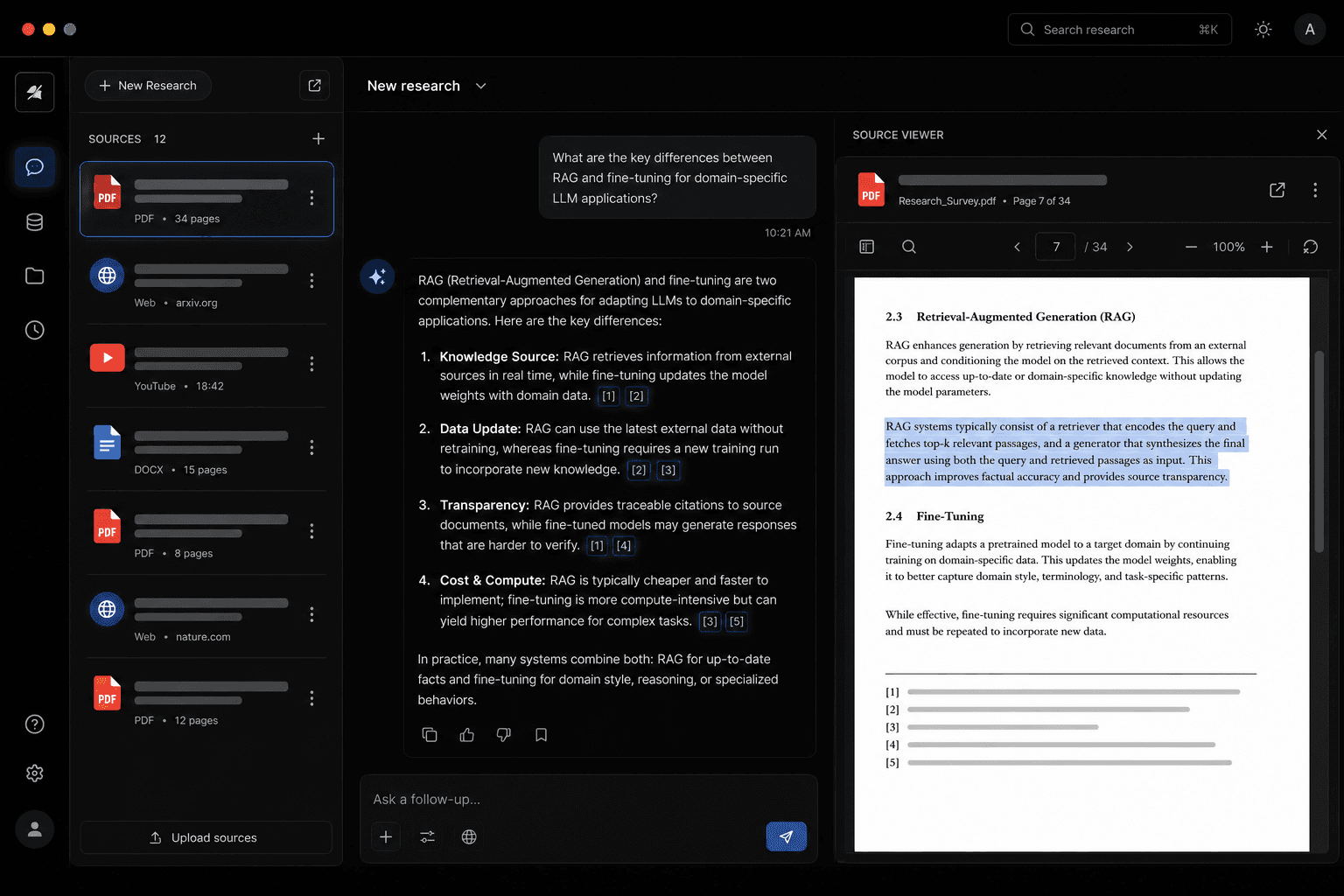
NotebookLM
PDF / web / YouTube / DOCX / VTT ingestion · hybrid retrieval + RRF + rerank · cited streaming answers · Source Viewer
- A NotebookLM-style research assistant: users create isolated notebooks, ingest sources, and ask natural-language questions grounded in those sources — every answer is cited back to the exact chunk (page, timestamp, or passage).
- Seven source types with per-type parsing:
- PDF (pdf-parse, per-page text), plain text, Markdown, DOCX (mammoth)
- Website URLs — Firecrawl scrape → markdown
- YouTube — captions via youtube-caption-extractor
- WebVTT transcripts — custom cue parser
- Async ingestion pipeline (BullMQ worker, decoupled from the HTTP path):
- parse → chunk → embed → index, with live status tracking (pending → parsing → chunking → embedding → indexing → ready/failed)
- sliding-window chunking (1000 chars, 150 overlap) for documents; greedy transcript-merge chunking for YouTube/VTT that preserves start/end timestamps
- idempotent re-index/delete — old Qdrant vectors and Postgres chunks are cleared before re-insert so no orphaned points accumulate
- 3 retries with exponential backoff on failure
- Advanced retrieval pipeline, not a single vector search:
- query transform step (DeepSeek) produces a rewritten query, a HyDE passage, a step-back query, and sub-questions — and can skip retrieval entirely for chit-chat
- parallel fan-out: each transformed query is embedded and searched in the notebook's Qdrant collection, plus a keyword full-text search on Postgres
- Reciprocal Rank Fusion merges all ranked lists, then Voyage AI's rerank-2.5-lite cross-encoder reranks the top candidates down to a final context window (falls back to RRF order if reranking fails)
- grounded prompt built with [[chunk-id]] citation markers, streamed via SSE, then parsed back into a citation list for the UI
- One Qdrant collection per notebook (not a shared collection with filters) — retrieval is scoped by collection, and deleting a notebook drops both the Postgres cascade rows and the Qdrant collection.
- Source Viewer: clicking a citation chip opens the original material at the right spot — PDF page via an authenticated blob iframe, text/markdown/DOCX with the passage highlighted, or a YouTube embed seeked to the cited timestamp.
- Local embeddings — Supabase/bge-small-en (384-dim, mean-pooled, L2-normalized) running on-device via @huggingface/transformers/ONNX, so embedding cost doesn't scale with a hosted API.
- pnpm monorepo: Next.js 16 frontend, Fastify 5 API + BullMQ worker as separate processes sharing the same codebase, and typed packages (db, queue, vector-store) so schema and client logic aren't duplicated.
- Clerk auth with JIT organization/user provisioning on first authenticated request, and ownership checks on every notebook-scoped route.
// tech
Next.jsTypeScriptFastifyDrizzle ORMNeon PostgresQdrantBullMQUpstash RedisClerkDeepSeekVoyage AIFirecrawlHugging Face Transformers